
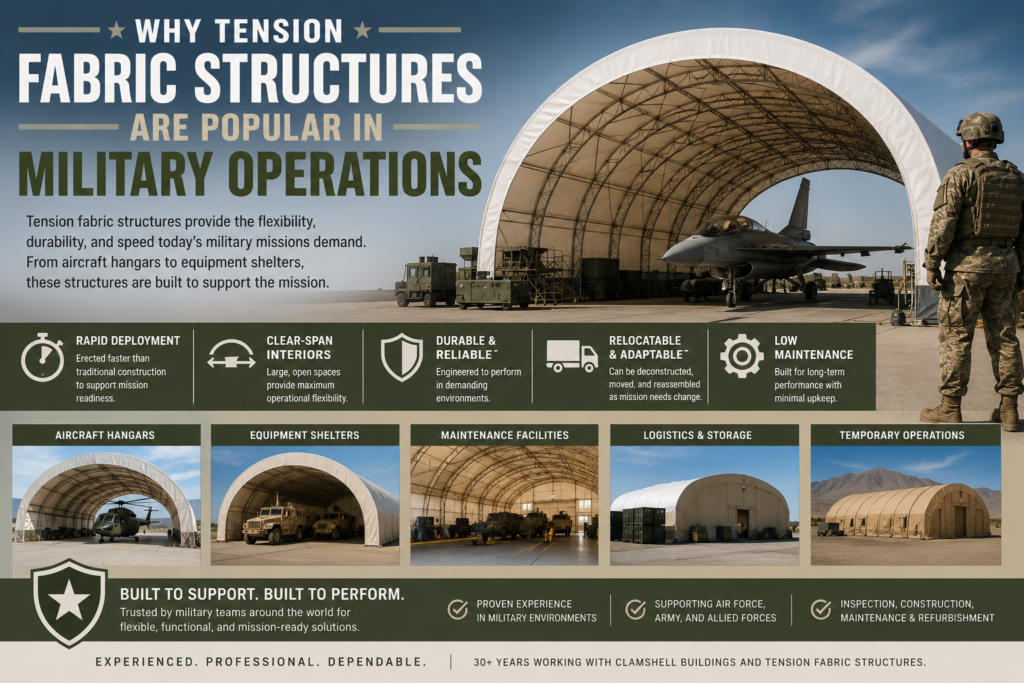
Military operations demand flexibility.
Facilities often need to be deployed quickly, perform in difficult environments, adapt to changing operational needs, and support mission-critical equipment without sacrificing reliability.
That is one reason tension fabric structures have become widely used across military operations around the world.
Whether supporting aircraft maintenance, temporary deployments, equipment storage, logistics operations, maintenance facilities, or mission support, military tension fabric structures offer a practical combination of speed, durability, flexibility, and operational efficiency.
But choosing the right structure—and ensuring it is installed, maintained, and repaired correctly—matters.
Military environments leave little room for shortcuts.
At Oilcanners Construction Consulting, military tension fabric structures are not simply a product category—they represent decades of hands-on field experience. With more than 30 years of experience working on clamshell buildings and clear-span tension fabric structures, the company has supported military-related projects involving aircraft hangars, field advisory services, inspections, maintenance, refurbishment, crew training, and construction oversight in both domestic and international environments.
That experience includes military support work involving the U.S. Air Force, Redstone Arsenal, Camp Castor (Royal Netherlands Air Force), Kabul, Afghanistan, and other specialized military aviation environments where reliability mattered.
In this guide, we will explain why military organizations continue choosing tension fabric structures, how they are commonly used, and what makes experience so important in military environments.
What Are Military Tension Fabric Structures?
A military tension fabric structure is a clear-span building system that combines a structural metal frame with a durable tensioned fabric membrane.
These structures are commonly used because they provide:
- Large clear-span interiors
- Operational flexibility
- Adaptability
- Faster deployment than traditional construction
- Relocatability
- Functional workspace in demanding environments
Military facilities often need to support changing missions.
Unlike traditional permanent buildings, many tension fabric structures can be adapted or relocated as operational needs evolve.
Common military applications include:
- Aircraft hangars
- Equipment shelters
- Maintenance facilities
- Logistics support buildings
- Mission support structures
- Vehicle storage
- Temporary operational facilities
The ability to balance performance with flexibility is one reason these systems remain popular.
Why Military Operations Use Tension Fabric Structures
Military operations often involve unique challenges.
Facilities may need to be installed in remote locations, changing operational environments, or mission-critical settings where timing matters.
Several advantages make tension fabric structures practical for military use.
Faster Deployment
One of the biggest reasons military organizations choose fabric structures is speed.
Compared to many traditional construction methods, tension fabric structures can often be deployed more quickly.
That speed matters for:
- Operational readiness
- Temporary deployments
- Aviation support
- Equipment protection
- Mission-critical operations
However, speed should never come at the expense of quality.
Military structures still require:
- Engineering coordination
- Proper structural alignment
- Membrane performance
- Correct installation procedures
Oilcanners Construction Consulting works directly with engineering resources to help ensure military structures are installed and repaired as designed, not simply erected as quickly as possible.
Large Clear-Span Interiors
Military operations often require open space.
Many tension fabric structures are designed as clear-span buildings, meaning there are no major interior support columns interrupting the workspace.
This becomes valuable for:
- Aircraft maintenance
- Equipment staging
- Vehicle access
- Maintenance operations
- Logistics movement
Open interiors improve operational flexibility and workflow.
For military aviation, clear-span aircraft hangars are especially useful.
Relocatability and Adaptability
Military needs change.
Facilities that make sense in one location today may eventually need to move.
One major advantage of many tension fabric structures is that they may be:
- Deconstructed
- Containerized
- Relocated
- Refurbished
- Reassembled
This flexibility helps military teams adapt to changing operational needs without necessarily starting over.
Oilcanners Construction Consulting has hands-on experience supporting deconstruction, relocation, and reconstruction projects involving military-related hangars and specialized tension fabric facilities.
Durability in Demanding Environments
Military facilities are often exposed to:
- Harsh weather
- Wind
- Extreme temperatures
- Heavy operational use
- Remote conditions
Properly installed and maintained tension fabric structures are designed to perform in demanding operational settings.
That said, long-term performance depends heavily on:
- Installation quality
- Engineering standards
- Routine maintenance
- Inspections
- Repair timing
Experience matters.
Common Military Applications for Tension Fabric Structures
Military tension fabric buildings are used for a wide range of operational needs.
Aircraft Hangars
Aircraft protection and maintenance remain one of the most common uses.
Military aviation facilities often require:
- Large clear-span interiors
- Rapid deployment
- Operational flexibility
- Space for maintenance and equipment
Oilcanners Construction Consulting has supported military aviation-related projects involving aircraft hangars, field advisory services, inspections, and construction oversight in demanding operational settings.
Equipment Storage
Military equipment often requires weather protection and secure storage.
Fabric structures provide adaptable solutions for changing operational requirements.
Maintenance Facilities
Military operations frequently require covered maintenance environments for:
- Aircraft
- Vehicles
- Equipment
- Specialized systems
Clear-span layouts often improve efficiency and access.
Temporary Mission Support Facilities
Not every military facility is intended to remain permanently.
Tension fabric structures are frequently used for temporary operational support due to their flexibility and speed of deployment.
Why Experience Matters in Military Projects
Military projects often have very little room for error.
Operational downtime, installation problems, or performance failures can create larger issues quickly.
That is why military environments often benefit from experienced support.
Oilcanners Construction Consulting brings more than 30 years of hands-on experience supporting military-related clamshell and tension fabric projects.
Past experience includes:
U.S. Air Force Training
Training Air Force personnel at MacDill Air Force Base on proper construction and deconstruction procedures for bare base teams.
Redstone Arsenal Support
Providing field advisory support for military hangar construction and maintenance operations at Redstone Arsenal.
International Military Operations
Supporting construction of aircraft hangars at Camp Castor in Africa for the Royal Netherlands Air Force, while training teams on proper construction procedures.
Kabul Aviation Support
Serving as field advisor during aviation hangar construction efforts in Kabul, Afghanistan, supporting military aviation-related operations.
Real-world experience matters because military environments often involve unique operational demands that cannot be learned from theory alone.
Common Mistakes in Military Tension Fabric Projects
Some of the most common problems come from:
Treating Military Structures Like Standard Construction
Military operations often require specialized planning.
Improper Installation
Small installation mistakes may eventually affect performance and durability.
Skipping Routine Maintenance
Preventative maintenance helps protect long-term reliability.
Hiring Teams Without Tension Fabric Experience
Military hangars and clear-span structures require specialized expertise.
Oilcanners Construction Consulting has experience with CB-designed systems, along with structures such as Bigtop, Shasta, and Celina, helping ensure military-related projects are installed and maintained according to intended design requirements.
Frequently Asked Questions About Military Tension Fabric Structures
Why does the military use tension fabric structures?
Military teams often choose them for speed, flexibility, clear-span interiors, adaptability, and operational efficiency.
Can military aircraft hangars be relocated?
Many fabric hangars can be deconstructed and reassembled depending on operational needs.
Are military tension fabric structures durable?
When properly installed and maintained, they are designed to perform in demanding environments.
What are military fabric buildings used for?
Aircraft hangars, maintenance facilities, equipment storage, logistics support, and temporary mission facilities are all common uses.
Why is experience important for military projects?
Military operations often require precision, reliability, and specialized understanding of tension fabric systems.
Need Help With a Military Tension Fabric Structure?
Whether you need aircraft hangar support, field advisory services, inspections, refurbishment, maintenance, relocation assistance, or turnkey construction expertise, experience matters.
Oilcanners Construction Consulting brings more than 30 years of hands-on experience working with clamshell buildings and tension fabric structures across military, aviation, and industrial environments. From Air Force training and military hangars to inspections, maintenance, and long-term facility support, the focus remains the same: helping ensure structures perform as designed.
Contact Oilcanners Construction Consulting today to discuss your project or request a quote.
